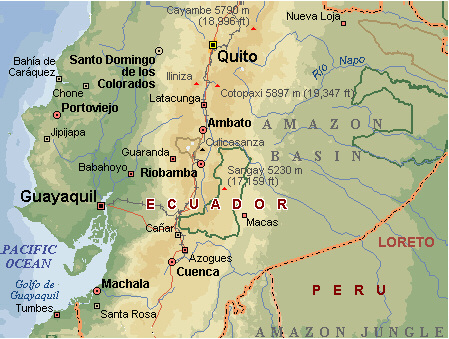
The Ecuadorian coastal city of Bahia de Caraquez committed itself through law to become ecological and sustainable. Planet Drum Foundation in San Francisco, California helped create community awareness of issues there at a celebration announcing the Ecological City Declaration in January 1999.
Since then, Planet Drum established a field office and carried out a major bioregional project to revegetate a city barrio [neighborhood] with native trees for erosion control against future mudslides and to create an urban “wild corridor.” We continued working on additional revegetation of hillsides, water supply and purity, household ecology education, composting, recycling, alternative energy, and others until 2021.
The Eco-Ecuador Project
Peter Berg was invited to visit Ecuador in early 1999 by Motohiko Kogo to help organize community support for his replanting of mangroves and to celebrate his First International Mangrove Day. At about the same time, the City of Bahía de Caráquez passed a resolution to rebuild as an eco-city after a year of El Niño rains followed by a 7.2 earthquake had greatly damaged the city. Peter traveled to Ecuador and held a series of bioregional workshops in Quito and and Bahía, after which the Mayor of Bahía and local Ecologists there asked Peter to be a consultant for their project to rebuild as an eco-city. He agreed and during twenty two years (1999-2021), Peter and Planet Drum developed an innovative and mutually advantageous relationship.
The Dry Tropical Vegetation of this bioregion is both specific and barely extant. The Project began as an effort to stabilize hillsides prone to mudslides by replanting a combination of indigenous trees, shrubs and grasses. Working with locals and international volunteers, thousands of indigenous trees were grown from seed and donated to the people in and around Bahía de Caráquez, Canton Sucre, Ecuador . The Project evolved to include bioregional educational classes, publications, murals, alternative energy, celebrations and composting and tree planting workshops.
Early in 2021 Kat, the Project Manager, came down with what appeared to be a mild case of Covid. By May, it was clear that she was dealing with long-term Covid , and she was forced to cut back her involvement with Planet Drum. Planet Drum’s role in Bahia was always difficult to maintain due to the distance involved, but became impossible without a Manager in Bahía so the Project was closed in June 2021. It remains a model for bioregional community and ecological restoration involvement, and Planet Drum continues relationships there.
Each Project Manager left a mark on the Eco-Ecuador Project. This page provides links to both the managers’ and educators’ reports, providing a compilation of who they are, what they did and links to their reports. Links to Peter Berg’s Dispatches from Ecuador are also included on this page. They contain his interactions, observations, events, and even recipes as the Project evolved in Ecuador.
Dry Tropical Revegetation Project & Bioregional Education Project
These became Planet Drum’s two primary projects in Bahía. The distinction between Revegetation Project Reports, and Bioregional Educational Project Reports is blurred and overlaps. Generally the Revegetation Project works with adults and the specifically Educational Project relates to children. But when the Revegetation Project donates trees to adults, there is education involved to ensure the trees survive. Similarly the children who are learning about their bioregion learn about the trees by helping grow them with the Revegetation Project.
Dispatches From Ecuador
Peter Berg visited The Eco-Ecuador Project every six months to solve problems and ensure that it continued to move forward. During and after these visits he sent back his impressions and ideas that were generated during the visit. His Dispatches From Ecuador document his experiences and include both difficulties and delights there. (The Dispatches include relevant letters to or from Peter as well as Bahía’s Eco-City Mandate, Ecuador’s new constitution including the granting of “Rights of Nature.” They occasionally include entries from Judy’s Journal by Judy Goldhaft, Planet Drum’s Managing Director, when she accompanied him.)
A Compilation of Links to Project Plans, Reports, Dispatches, & Updates
This is the central index to materials which document the collaboration between the coastal city of Bahía de Caráquez, Ecuador and Planet Drum Foundation, planetary citizens who may be separated by national boundaries but share a common devotion to a more natural agenda. Links to the specific projects and by specific years are below. Link here to downloadable educational manuals/workbooks and testimonials by project participants.
Timelines by Project
(brief overviews plus links to reports)
Dry Tropical Revegetation Reports (1999-2021)
2012-2021 Reports include Bioregional Education
Bioregional Education Project(2002, 2004-2011)
2002,2005-6 Education Reports are also included in the Revegetation Index because those years the projects worked closely initiating the educational program. After 2011 the projects merged again.
Dispatches from Ecuador (1999-2010) by Peter Berg
Timelines by Year
(brief overviews plus links to all of that year’s reports)
Scroll down or jump to a specific year with these links: 2021, 2020, 2019, 2018, 2017, 2016, 2015, 2014, 2013, 2012, 2011, 2010, 2009, 2008, 2007, 2006, 2005, 2004, 2003, 2002, 2001, 2000, 1999.
2021
Dry Tropical Revegetation Reports (Kat Castillo)
During 2021 Kat worked with community clean-ups, collecting and germinating native tree seeds and working with the city on highway and community revegetation. She researched a Food Forest project and explored various ways for the project to continue, supporting riparian clean-ups and initiating new children’s educational opportunities.
Covid travel restrictions eliminated international volunteers plus curfews, lack of public transportation, and social distancing all took tolls on activities. Kat weathered these increased difficulties. However. she came down with what seemed to be a mild case of Covid, but by May, it had become clear that she was dealing with long-term Covid, and she was forced to cut back her involvement with Planet Drum’s Project. Without a project manager, Planet Drum’s role in Bahía was impossible to maintain. Consequentially the Project was closed as of June 2021.
2020
Dry Tropical Revegetation Reports (Kat Castillo)
Kat Castillo, the new Project Manager, has begun building a community garden in an empty lot near the new Planet Drum house. She is also working with the University’s eco-club. After working on the Community Garden for 9 months, the project had to be abandoned as the plot, which was originally identified as belonging to the city, actually was privately owned and the owner reclaimed possession.
2019
Dry Tropical Revegetation Reports—late 2019 and early 2019 (Clay Plager-Unger)
Clay Plager-Unger continued as Field Project Director until the end of October 2019 when Kat Castillo became the new Project Manager. Kat spent the last two months of 2019 orienting herself to the project.
Early 2019 activities included presentations at an environmental forum hosted by the city, a biodiversity conference held at the Technical University of Manabí, and an eco-fair for school children. Planet Drum is also collaborating with a new eco-club in Bahía and a municipal project to vegetate 32 kilometers of highway. Matt Timmins, from Photographers Without Borders, joined the project in June to document it.
During September and October, Clay’s last months, he collaborated with the Universidad Católica (Catholic University) on a course to introduce university students to bioregional concepts. The plan was for Kat to teach the same class during the beginning of 2020 and 2021, however those classes were cancelled due to Covid-19.
2018
Dry Tropical Revegetation Reports (Clay Plager-Unger, Field Project Director, Orlando Arias, Field Project Manager & Educator)
Community involvement in neighborhood greenhouses and composting; expanded producing trees for residents, and hillside revegetation; interns designed and produced a composting toilet and developed gardens at several schools. International volunteers and interns took several field trips this summer—to Chirije, an archeological dig site, and to Punta Gorda, a Nature Reserve. In July and August a 3 week study-abroad session called Sustainable Development in Latin America was held in collaboration with the University of Oregon.
2017
Dry Tropical Revegetation Reports (Clay Plager-Unger, Field Project Director, Orlando Arias, Field Project Manager & Educator)
Planet Drum held a month long study-abroad program with the University of Oregon, and a revegetation workshop for a group from Sustainable Summer. Trees cultivation continued and distribution was aided by CNEL (The National Electric Company). Community outreach with neighborhood greenhouses and composting continued as well as the apiculture project. Planet Drum also prepared new bioregional education & mapping materials.
2016
Dry Tropical Revegetation Reports (Clay Plager-Unger, Field Project Director, Orlando Arias, Field Project Manager & Educator)
The year began well with an eco-city celebration and reforestation coordinated in the entire Province, but on April 16th there was an 7.8 earthquake creating massive damage in the city. Nevertheless in July an erosion study was begun by an Field Research Intern and Planet Drum collaborated with Ricardo Lopez to begin a bee-keeping project.
2015
Dry Tropical Revegetation Reports (Clay Plager-Unger, Field Project Director, Orlando Arias, Field Project Manager & Educator)
The National Electric Company (CNEL), organized tree donation events with Planet Drum. This year’s reports include an overview of the revegetation project.
2014
Dry Tropical Revegetation Reports (Clay Plager-Unger, Field Project Director, Orlando Arias, Field Project Manager & Educator)
Clay and Orlando, with help from The National Electric Company (CNEL), distributed 8000 trees. They also initiated a new program of helping residents plant trees in their yards.
2013
Dry Tropical Revegetation Reports (Clay Plager-Unger, Field Project Director, Orlando Arias, Field Project Manager & Educator)
Clay and Orlando continue revegetation projects with international volunteers. Greenhouse production nearly doubled. Thousands of trees were distributed locally with Revegetation Manuals to help insure their survival. The format for Environmental Education was revised so that groups of students from several local schools visit the greenhouse to learn about and participate in ecological revegetation and restoration.
2012
Dry Tropical Revegetation Reports Clay Plager-Unger, Field Project Director, Orlando Arias, Field Project Manager & Educator
Clay and Orlando continue revegetation projects. The Bioregional Sustainability Institute hosted the first University Study-Abroad class which visited for three weeks in September from the University of Oregon with their teacher, Gerardo Sandoval. A Revegetation Manual was created with extensive help from Hari Khalsa, an intern during the Fall 2012.
2011
Dry Tropical Revegetation Reports (Clay Plager-Unger)
Clay Plager-Unger and new Field Manager Orlando Arias continue revegetation projects. In addition Sustainability Institute Classes were taught by them along with Ramon Cedeno Loor.
Bioregional Education Project Reports (Ramon Cedeno Loor, Nadine Flexhaug,& Margarita Avila)
The Bioregional Education classes resumed in May with three classrooms again this year.
2010
Peter Berg’s Dispatches
Peter Berg visited in November to help initiate the first classes of the Bioregional Sustainability Institute.
Dry Tropical Revegetation Reports (Clay Plager-Unger)
Clay Plager-Unger and new Field Manager Orlando Arias continue revegetation projects.
Bioregional Education Project Reports (Ramon Cedeno Loor, Nadine Flexhaug,& Margarita Avila)
The Bioregional Education classes resumed in May with three classrooms again this year. Ramon Cedeno Loor continued as the main Bioregional Education teacher, and additional classes concurrent were classes taught by Margarita (Avila) Plager-Unger and Nadine Flexhaug.
2009
Peter Berg’s Dispatches
Peter Berg visited for the 10th Anniversary of of the Eco-City Resolution.
Dry Tropical Revegetation Reports (Clay Plager-Unger)
Clay Plager-Unger currently continues as Project Manager. Jaime Andraide worked as the Field Manager during the first six months of the year.
Bioregional Education Project Reports (Ramon Cedeno Loor, Paola Divita & Fabiola Coella)
Ramon Cedeno Loor continued as the main Bioregional Education teacher, but additionally classes were expanded to include two other concurrent classes taught by Paola Divita and Fabiola Coello.
2008
Peter Berg’s Dispatches
Peter Berg’s Dispatches include Bahía’s Eco-City Mandate 2008, discussions about Ecuador’s new constitution and its “Rights of Nature,” and a document describing Planet Drum’s Bioregional Sustainability Institute. Judy Goldhaft’s journal entries describing her adventures in Bahia and as a Planet Drum revegetation volunteer are included with the Dispatches.
Dry Tropical Revegetation Reports (Clay Plager-Unger)
Clay Plager-Unger and Jaime Andraide continue revegetation projects, expanding the number of sites and the greenhouse. Fred Alvarado paints a mural with school children. Clay also continues exploring the land for the Bioregional Institute.
Bioregional Education Project Reports (Ramon Cedeno Loor)
Ramon Cedeno Loor has a new Bioregional Education Class with students from the previous Advanced class acting as assistants. The Bioregionalism textbook is updated.
2007
Peter Berg’s Dispatches
Peter made trips to Bahia in March and September in 2007. He writes about the land that Planet Drum has purchased for a Bioregional Institute and setting up a meeting with the Amigos de la Eco-ciudad (Friends of the Eco-City) Two letters by Judy Goldhaft describe the happenings in Bahia, including a visit by the new president of Ecuador.
Dry Tropical Revegetation Reports (Clay Plager-Unger)
In January Clay Plager-Unger came to Bahía to be Planet Drum’s Field Projects Manager and joined Ramon Cedeno Loor, the Bioregional Education Manager. During this year Jaime Andraide, a local who is an expert Ecuadorian forestry, became the Field Manager for the Revegetation projects in Bahía. Clay worked closely with Jaime and included both their work in his Reports.
Bioregional Education Project Reports (Ramon Cedeno Loor )
Ramon reorganized the classes and in May 2007 he began a new series of Introductory classes. In October he initiated an Advanced class.
2006
Peter Berg’s Dispatches
Peter returned to the Eco-City project in Ecuador in March and later in September, 2006. He sent dispatches to report on the project’s progress as seen through his eyes.
Dry Tropical Revegetation Reports (Heather Crawford, Patrick Wylie, Dan Robbins, Sarah Couture)
In March, 2006, Patrick Wylie replaced Heather Crawford as Planet Drum’s Field Projects Manager in Ecuador. In November, 2006, Dan Robbins replaced Patrick, who was unable to renew his Visa, and he and other volunteers continued sending updates on the work in Eco-Ecuador.
Bioregional Education Project Reports (Valentina Carminati & Ramon Cedeno Loor)
Local teacher Ramon Cedeno Loor replaced Valentina Caminati in November as the new Bioregional Education Manager.
2005
Peter Berg’s Dispatches
Peter returned to the Eco-City project in Ecuador in early February, 2005. His first Dispatch arrived near the end of February. He sent four Dispatches during this year.
Dry Tropical Revegetation Reports (Heather Crawford, Renée Portanova, Riccardo Clemente, et al.)
Riccardo Clemente held Solar Energy workshops and built a Solar Hot water with local contractors Heater in January. Renée Portanova, Field Projects Manager, left at the end of March 2005. Heather Crawford began training to become the new Field Projects Manager in February 2005.
Bioregional Education Project Reports (Kristen Lansdale)
Kristen Lansdale arrived in April to head the new Bioregional Education Program.
2004
Peter Berg’s Dispatches
Peter returned in early June, 2004, to the Eco-City project in Ecuador. He began sending dispatches soon after. The first Dispatch is the often-reprinted essay Learning to Partner with a Life-Place.
Dry Tropical Revegetation Reports (Renée Portanova, Brian Teinert, Elise Braaten)
Renée Portanova arrived in Bahia in late January and after working as a volunteer, became the new Field Projects Manager after Brian left in May. Her and other volunteers’ reports for 2004 are here.
Bioregional Education Project Reports
Peter Berg and Elise Braaten collaborated on a neighborhood oriented educational curriculum that will be launched June 2004 by Planet Drum Foundation in Bahía de Caráquez.
2003
Peter Berg’s Dispatches + a Presentation
In mid-January Peter sent a comprehensive dispatch which reviews Planet Drum’s accomplishments and visions over the past five years in Ecuador. He also gave a presentation in Ecuador (21 Feb, 2003). This talk represents the latest strategic thinking on creating sustainable bioregional activities and is included with the Dispatches. He returned to Ecuador in November and continued sending Dispatches.
Dry Tropical Revegetation Reports (Brian Teinert)
We started out the new year with one volunteer, Simon Winch, working on the Eco Ecuador Project. In early January Peter arrived, and about a week later Brian Teinert, who has been hired as Field Projects Manager arrived to carry on the work. Peter was busy organizing the projects in Bahia and introducing Brian to everyone. Brian sent Reports of activities during 2003 and part of 2004
2002
Peter Berg’s Dispatches
Several volunteers joined Peter in Ecuador to continue the revegetation work amidst downpours and mud slides. These Dispatches include a Statement of Intent to revegetate eroded hillsides, and a Management Plan for Fanca Produce Composting.
Dry Tropical Revegetation Reports (Jeff Godden, Simon Winch, Sara Gomez and Matt, Chris Haaf, Kristen Ford, and Lisa Kundrat)
Fall 2002 Ecuador volunteers included: Jeff Goddin, Kristen Ford, Chris Haaf, Sara Gomez (& Matt), Rita Higgins, Simon Winch, Lisa Kundrat and others for short times (Justine and Maggie, etc.) Almost everyone sent reports.
Bioregional Education Project Reports
Besides working with the revegetation project, Kristen Ford was the first volunteer to focus on children’s education. Her reports include forays finding schools to work with and experiences learning from her “students.” Her amazing Escuela Rotaria Story is the first time Planet Drum worked with a teacher in a specific school in Bahia.
2001
Peter Berg’s Dispatches
Peter Berg returned to Ecuador in January and February, 2001, to continue work on the Revegetation project and to participate in the growing Eco-Ciudad movimiento (Eco-City movement) in Bahía de Caráquez. These are his reports from the scene. In August/September he continued work on the Eco City. Included with the Dispatches is:
- Ecological City Plan for the Development of Canton Sucre (Bahía de Caráquez, Ecuador)
Final version approved Feb. 15, 2001 by the Public Meeting. (in English and Spanish) - Report on Bahía de Caráquez Hillside Erosion Suitable for Revegetation Using Plantings Without Physical Alterations of the Landscape
Dry Tropical Revegetation Reports (Amy Jewel)
Amy Jewel worked in Ecuador this Spring (2001). She sent two reports that follow up on the events set in motion with the Eco Committee’s proposals and subsequent Public Meetings held in February. With her background in Waste Management, she wrote:
- Preliminary Waste Management and Recycling Plan for Municipality of Canton Sucre (in English and Spanish)
2000
Peter Berg’s Dispatches
On his third visit to Bahía, in February 2000, Peter Berg opened Planet Drum’s local office and inaugurated the Revegetation Project, to restore the hillsides devastated by the 1998 El Nino mudslides. Peter sent six dispatches that reported on this work. Planet Drum staffers Peter Berg and Judy Goldhaft returned to Bahía in early September for further work in various areas of urban sustainability. These dispatches tell the status of their efforts in the hillside revegetation, water supply, alternative energy and other projects.
Dry Tropical Revegetation Reports (Carey Knecht, Claire Dibble, San Francisco events)
Carey Knecht was Planet Drum’s first Field Manager. Her reports are from February-March. and volunteer Claire Dibble sent two reports (October-December) “from the ground” on the Eco City hard work of planting the hillsides, with fervent wishes that the native vegetation will hold when the storms come this winter.
This year the City San Francisco adopted a resolution commending Ciudad Bahía de Caráquez of Ecuador on becoming an Eco-City and Planet Drum Foundation launched an Eco-Bahía Ecuador Support Group in San Francisco December 8.
1999
Peter Berg’s Dispatches
Peter Berg went to Ecuador in February, 1999 to attend the International Eco-Gathering and help the local ecologistas organize in the midst of natural disasters that have beset the Bahía de Caráquez region over the past two years. We anxiously awaited for these seven dispatches that Peter sent back over the two-week period. These reports from 1999 illuminate the genesis of this unique collaborative effort.
Dry Tropical Revegetation Report (Peter Berg, Patricio Tamariz)
Out of the meetings that Peter had in Ecuador came a By-Law declaring Bahía de Caráquez an Eco-City. We offer it here as a model that other municipalities may use in developing language appropriate to their specific bioregions. Patricio Tamariz reports on subsequent activities after Peter left to return home at the end of March, 1999. It includes photos of the first plantings in what would become the revegetation project.
In order to get a first hand view of the situation since the Eco-Gathering, Peter made a second visit to Bahía in August, 1999, accompanied by Judy Goldhaft, Planet Drum’s Managing Director. They wanted to survey the positive activities that the Bahians had already started, what support they needed, and how their projects could be tied to large-scale infrastructure improvements. The resulting report by Peter Berg outlines the Planet Drum proposal.